
Services
Crash Engineer provides accurate and clear accident reconstruction services. We inspect, analyze and interpret data, as well as create stunning graphics and animations that leave very little to be questioned.
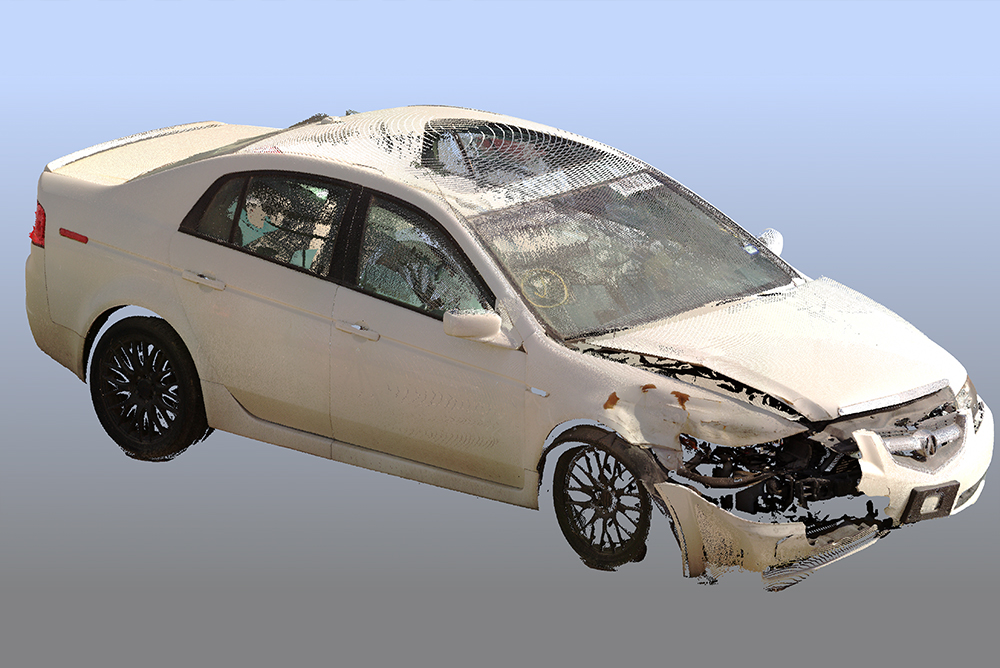
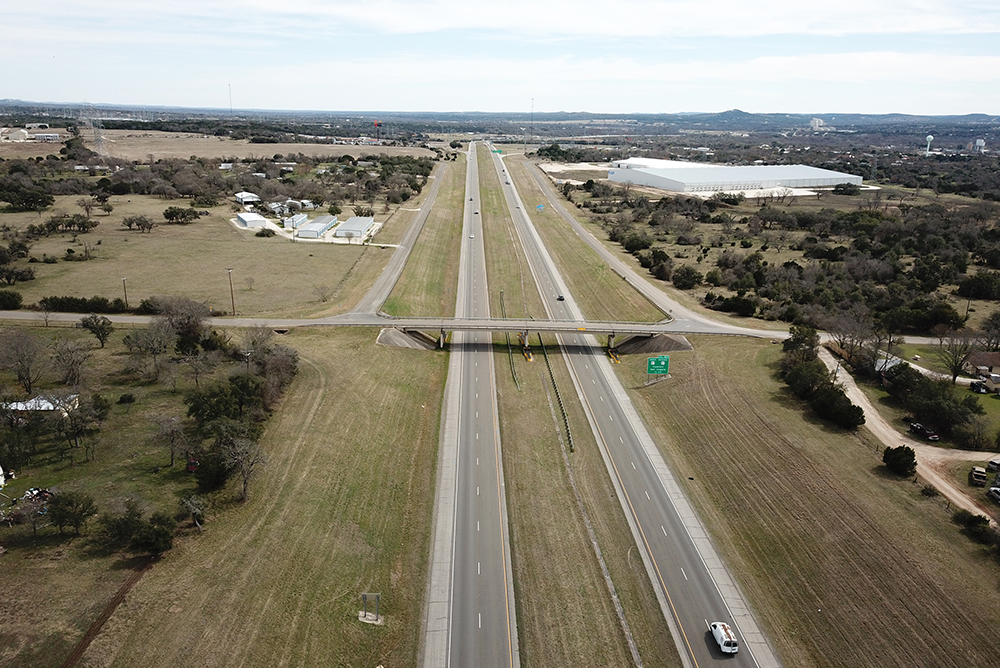
We use a 3D Digital Scanner and 4K Drone Aerial Photography to accurately capture evidence, vehicle damage, and create high-resolution orthomosaics and 3D models.
Inspections
FARO Scanner
Crash Engineer, LLC utilizes the most advanced three-dimensional software and equipment to accurately capture the roadway geometry, evidence, and vehicle damage. Once the evidence has been captured on-site, it is then brought into the office for further analysis. We accomplish this sophisticated modeling method with the use of FARO 360 laser scanners to capture a 360-degree view over short and long range distances.
Drone Aerial Photography
We are equipped with FAA certified remote pilots for operating drones to capture roadway evidence with high quality 4K resolution. With drones, we are able to perform roadway surveys in a fraction of the time with high precision to create high-resolution orthomosaics and 3D models.
ANALYSIS
Energy
The severity of a collision is defined in terms of Delta-V, or change in velocity. Delta-V is computed utilizing energy methods. The energy methods employ an algorithm that utilizes the amount of crush to the vehicle, the direction of material deflection and the stiffness factors associated with the vehicle’s damaged structure. The amount of crush and direction of material deflection is determined from the vehicle inspection. The stiffness factors vary from vehicle to vehicle as well as the involved part of a vehicle such as the rear, front or side. The stiffness factors are derived from crash tests.
Momentum
A momentum analysis is typically performed to compute the impact velocities of the vehicles. Momentum is defined as the vehicle’s mass multiplied by its velocity. In a collision, the colliding vehicles exchange momentum. However, the after impact momentum remains equivalent to the before impact momentum. The calculation for momentum is based on the before and after travel directions of the vehicles and the distances traveled after impact. These travel directions and distances are determined from evidence collected during the site inspection and from the digital mapping.
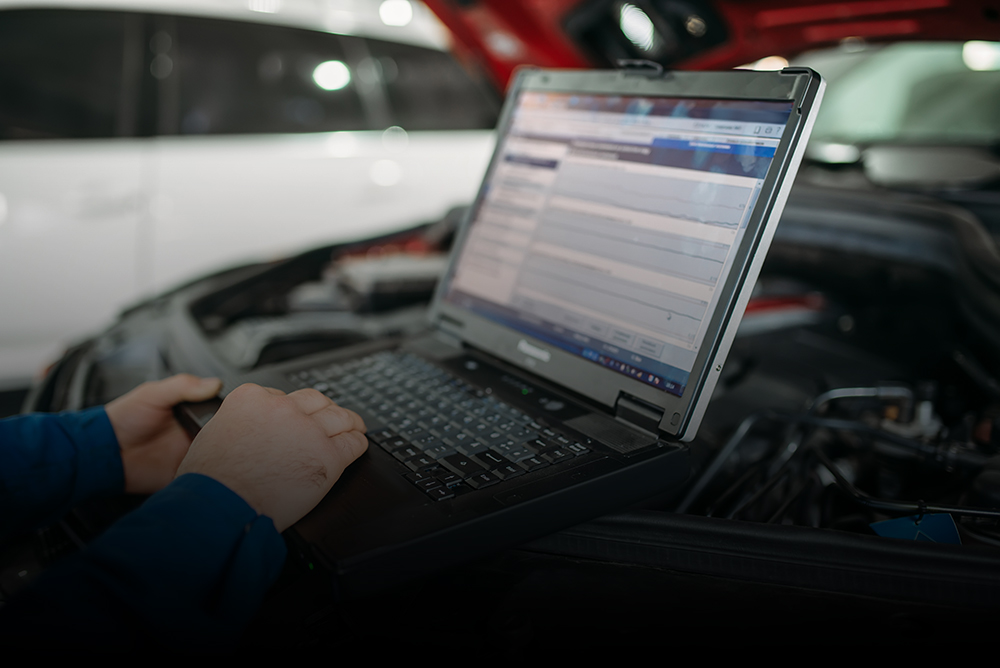
Event Data Recorder (EDR) and Engine Control Modules (ECM) are capable of recording data during a crash event that we utilize to corroborate the results of the accident reconstruction.
Crash Data Retrieval
Passenger Vehicles
Most passenger vehicles are equipped with airbag systems that are controlled by modules that contain an Event Data Recorder (EDR). The EDR is capable of recording data during a crash event. The data may be retrieved after a crash using a commercially available tool. The EDR may record deployment or non-deployment events. This means that the airbags do not have to be deployed during a crash for there to have been data recorded. The data may include crash severity (Delta-V) as well as pre-crash data such as vehicle speed, engine speed, throttle position and brake application. Other vehicles may record crash related data by other means such as the Powertrain Control Module (PCM) in some Ford vehicles.
Heavy Trucks / 18 Wheeler Tractors
Heavy trucks are equipped with Engine Control Modules (ECM) that monitor and report conditions of the truck such as fuel consumption, miles driven and oil pressure. The ECM is also capable of recording data during a crash event. Vehicle speed, engine speed, throttle percentage, cruise control, braking and other variables are typical parameters reported during a crash involving a heavy truck.
Data Interpretation
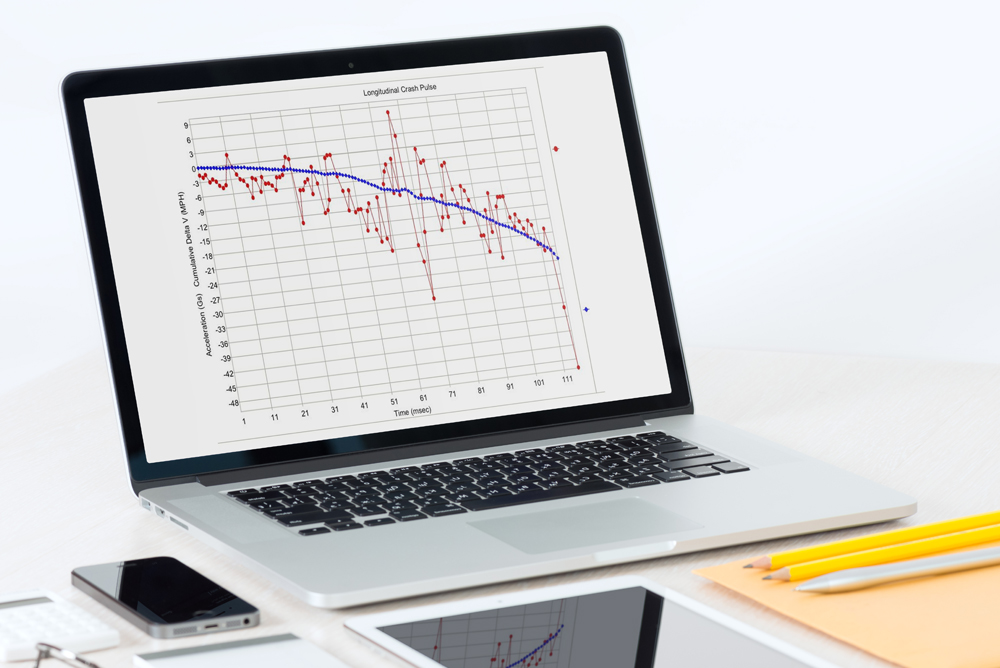
Gathering evidence has evolved with increasingly more information than just roadway marks and vehicle damage. We utilize the Crash Data Retrieval (CDR) and the Engine Control Module (ECM) tool kits to forensically image module information and analyze its data.
Data collected from passenger vehicles and heavy trucks is utilized to corroborate with the results of the accident reconstruction. Once it is determined that the data is representative of the physical evidence of the crash, the evaluation of other factors such as timing and position of a vehicle prior to impact or whether a vehicle stopped at a signal light may be made. Data that is collected from an EDR or ECM module may sometimes be proven to have inaccuracies due to such things as a vehicle malfunction, from the method used to collect the data or from circumstances surrounding the nature of the crash event itself. A proper interpretation of the data and the association of the data with the results of a reconstruction based on physical evidence is critical.
We strive to be up-to-date with forensic technology and software and provide clients with all the information that can be retrieved.
Crash Engineer, LLC is capable of describing the results of an accident reconstruction with traditional charts, diagrams and graphs as well as with stunning graphics and animation.
Simulation
Computer simulations are developed to model the motion of the vehicles during the collision. The simulations utilize data related to the physical evidence such as measurements of skid marks and vehicle damage as well as data related to crash testing or surface friction tests that have been performed. Simulations are conducted to confirm other calculations of energy and momentum and are useful for testing varying vehicle parameters such as speed, acceleration
Animation
The greatest efforts in accident reconstruction sometime come without merit due to a communication barrier between expert and jury. Sophisticated charts, graphs and scaled diagrams may be utilized effectively in conveying results and demonstrating trends. However, some jurors may not always be able to understand all aspects of what a chart or diagram may be depicting. Or sometimes very simple concepts may be misinterpreted or misunderstood during testimony.
Industry accepted accident reconstruction software and other mathematical models are utilized to accurately reconstruct, simulate and model the collisions. Then taking the results of the reconstruction and simulation, we are able to create accurate and compelling graphic illustrations and animations. We utilize computer simulations to model the crash events based on the physical evidence. We are then able to provide powerful graphics and animations based on the simulation results to create a virtual depiction of a crash event. Our graphics and animations are vivid, offer compelling detail of a crash event, and accurately and convincingly convey the results of the accident reconstruction leaving very little to be questioned.